
I have brief coffee news. For the first time in four years, we have enough unroasted peaberry mid-year to offer some for sale. The quantity is very limited, so we are going to do the same roast for all: medium-dark. The opportunity will first be sent out via an email to subscribers. Then an email will go out to the rest of our email list. The actual roasting date isn’t fixed, but it’ll be mid-June.
June 1 starts the hurricane season here, lasting to November 30. It isn’t until late July/early August that a tropical system is more likely. With the Kona low storms and the big earthquake fresh in our memories, maybe we will finally finish our family’s emergency preparations. Even when we lived in California, I felt our preparations were 85-90% done for many years. We just couldn’t quite get it to even 95%. Since it’s rural here and we have many natural disasters, it’s more important for each family to be prepared.
If you were interested in the recent earthquake, you might find these two articles engaging. This first one highlights a family-owned coffee business I’ve admired over the years. They are further south and were closer to the epicenter. Sadly, they were affected by both the Kona low storm and the quake. The Big Island Now piece explores the earthquake’s relation to the volcano.
Just this morning (6/1/26 4:40am local time) Episode 48 made history. USGS wrote, “The Halemaʻumaʻu eruption now has the most fountaining episodes ever recorded for an episodic fountaining eruption, edging out the Pu‘u‘ō‘ō eruption which had 47 fountain episodes. Other eruptions have had additional episodes related to changes in vent activity and location, this only applies to episodic fountains.”
I still want to share my Episode 47 story. We had house guests then, and they were going to spend a few nights in Hilo. Getting to Volcano is faster from Hilo than from our place. We all knew that fountaining would happen soon. I told them that anytime they woke up in the middle of the night, they should check the webcam.
I woke up early on May 14 and checked the webcam first thing. There were two small domes of red lava, and the lava was pouring out making two rivers. Dome fountaining is usually a precursor for real fountaining. I texted our friends in Hilo to share the news, and it turns out they were already at the park! They had left their B&B at 4:30am! Maybe I had scared them about possible six mile traffic jams to enter the park during fountaining. Driving from the east (Hilo side) involves a left turn, and traffic isn’t controlled.
With them already on site, they were able to give me updates of what they could see, how crowded it was, and what the parking situation was like. The fountaining hadn’t started yet, and the red lava was going on and off. It’s surprising how quickly red lava would cool and appear black during the day. But since they were already there, it made going to volcano early more enticing. We left immediately after breakfast.
We already had packed our volcano day trip bags the day before, knowing it would happen soon. So it took little thought to just go. We picked up bentos and a few snacks, and it was a smooth two-hour drive to the park. It was reverse of the Thursday work commute (many Ocean View people drive north to the Kona area on weekdays).
When we reached the park entrance kiosk at about 9:20am, there were only two cars ahead of us, but cars were rapidly arriving. Before we parked for the day at our desired lookout, Keanakākoʻi, we checked out the view from Uēkahuna. It’s where Jaggar Museum used to be. Keanakākoʻi and Uēkahuna are on opposite sides of Kaluapele (the traditional Hawaiian name for Kīlauea caldera). We were last at the park in November, before the recent episodes that had spewed lots of tephra. The landscape was transformed. The photo comparison below is even more dramatic than November to May, since the left photo was taken ten years ago.

The tephra everywhere reminded me of snow. And the piles, the result of cleaning the parking area, also reminded me of piles of snow remaining after snow plowing.


Next, we drove to the opposite side of the caldera to park by the Keanakākoʻi Outlook, our goal for the day. By then (around 10am) the parking lots in the area were full. Our friends had secured a spot early in the morning, when there were still several to be had. We had to park in the shoulder on the Chain of Craters Road. I felt a sense of accomplishment, the satisfaction of having been prepared. We had bags with everything we needed (I thought at the time). We had food, layers of clothing, rain gear, binoculars, extra water and other miscellaneous items either in our day bags or in the truck. We had an easy, uneventful drive to the park, it wasn’t too crowded, and we had our parking spot. Now, the volcano just needed to fountain. The hard parts were all done.
By now, our friends were resting in their car in the parking lot. We texted, dropped a pin on a map to show where we were. They walked to us and we went on a little hike while we all waited for the big event.

Right at the start, one friend picked up an enticing piece of light, aerated volcanic rock that looked like 3/8″ thick candy bark or toffee. He easily squished it between his fingers, and then was surprised when all his fingers were bleeding. The photo to the left was another form of tephra that fascinated all of us. It looks like foam. We all got great satisfaction from stomping on these. It was akin to popping bubble wrap, but better.
We had been apart from our friends for less than a day, but they already had colorful, amusing tales to share. Apparently, the B&B they booked turned out to be an odd experience. From their stories, I had images of them experiencing it like Hitchcock’s Bates Motel. Something highly unusual must have been going on for the B&B owner. It was sufficiently surreal and disorienting that they joked they could have disappeared from the island there. Not about to risk bedbugs, one friend slept on her bed on top of beach towels brought from our house. And she placed her suitcase in the dry bathtub! They canceled the rest of that booking, were promised a refund, and found another place in Hilo for that night.
After the little hike, snacking and talking story, they were ready to relax in an even more civilized manner. Lunch and a beer at Volcano House seemed more enticing than keeping their parking spot. We separated ways. They had already been to the outlook, and it was our time to go and wait.

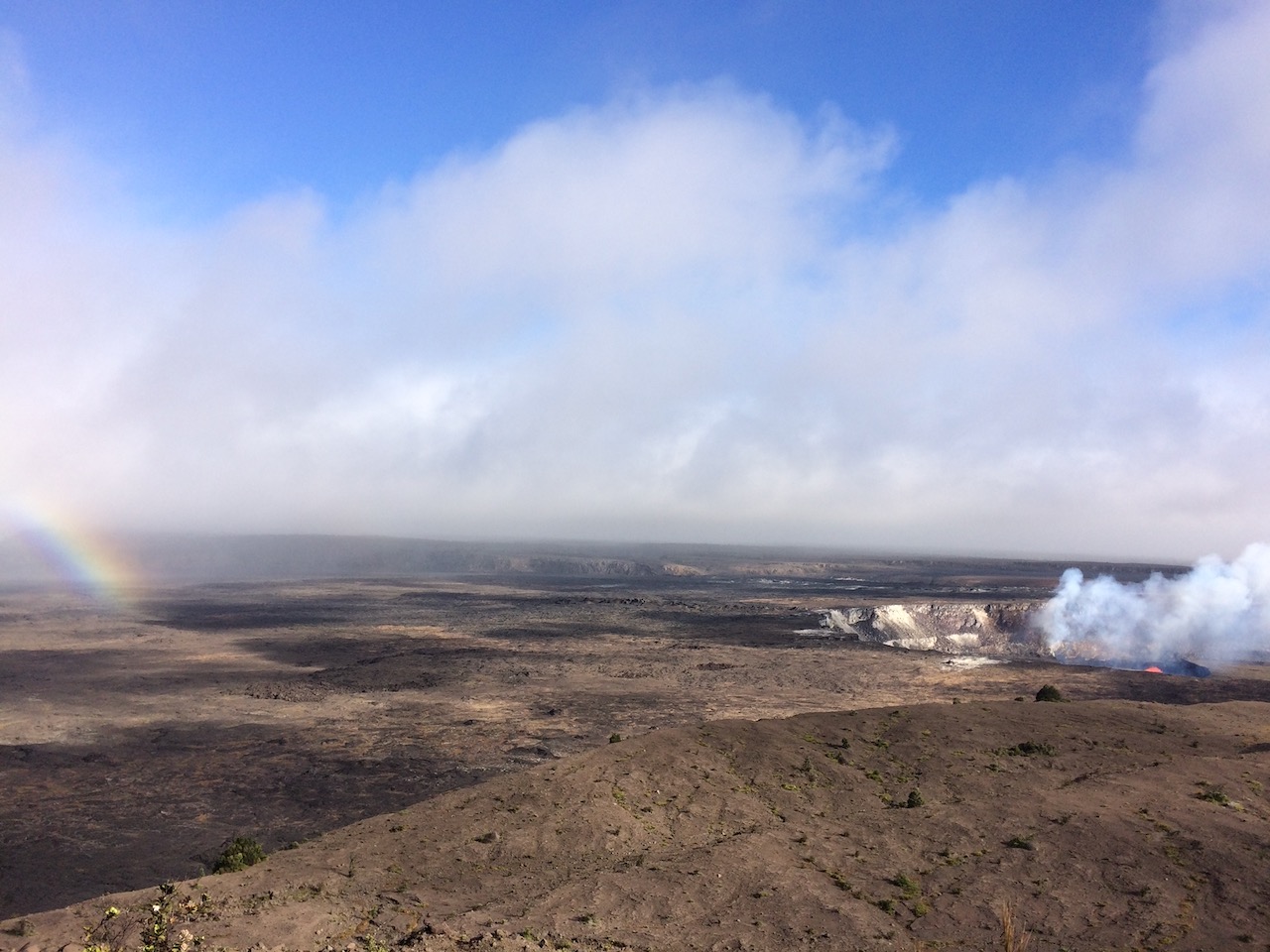
Hubby took this photo, my favorite of the day. There’s no red lava to see, no fountaining, no excitement. I appreciate the lighting of the sky, the guy with the umbrella in the foreground, the dark, heavy sky right over the light-colored umbrella. The image captures the patient waiting required to witness the start of an eruptive episode.
We sat behind this guy for hours. I think he had been there since early morning or maybe the night. Because he sometimes popped up his umbrella, either for rain or sun, Hubby and I sat next to each other, but about four feet apart. The umbrella blocked Hubby’s view if he sat next to me. And since we sat for hours, and we’ve been married a long time, we weren’t always talking. It’s all been said, and we can read each other’s minds. (I’m being facetious). We probably looked like two unrelated people just hanging out, waiting.
It was predicted to happen that day. I witnessed first-hand and could now better appreciate how rapidly red lava could pour out, and then the little dome fountain and overspill could just stop. The red lava would quickly cool to just dark grey during daytime. At night the bits of red would more clearly show up, but during the day, it just looked dark. If you looked only at those times, which could be hours, you wouldn’t have imagined it was red and flowing earlier. I can be pretty patient, especially if I have food and water.
For my first time, I was there before, and at the time of, the official start of fountaining. Throughout the year I had occasionally scrolled back on the webcam to the official start times of a few episodes to see what the start looked like. I could never visually distinguish what made the activity different to be called the start. The scientists measure and correlate various phenomena. In any case, for Episode 47 we learned maybe 15 minutes later that the official start had been at 3:27pm. A woman nearby had checked the USGS short messages, quick status updates. USGS messaged about it six minutes after the fact.


It had been lightly raining off and on, with occasional sunny periods, the entire time we were at the park. After a while, we decided to return to our truck, dry off, warm up, eat, rest and get ready to watch from dusk to night.
We returned for Round 2 of lava watching. There were many more people now that the official start had been announced. We were feeling tired, despite being slightly rejuvenated, and it was still some time before it’d be dark. We weren’t even halfway to the outlook when we started to feel light rocks landing on us. At first Hubby thought they were blowing down on us from the trees. Earlier we had seen a lot of tephra stuck in trees. I looked up towards the sky, studying what was coming down from where. I knew what I was doing wasn’t wise, but I couldn’t help but look up to figure out what was happening. I had no eye protection on. I had left my sunglasses in the truck, because this was our dusk-to-dark outing. But then others confirmed that tephra was indeed coming down from the sky. Bah!

All day I could see that the wind was blowing the smoke and debris to the west. I thought we’d be safe from tephra. What I only realized that day was that it’s the eruption plume height that matters. The plume reached heights of 20,000 feet and winds carried and distributed small tephra and Pele’s hair. I did not want those glass hairs in my eyes, nose, mouth or lungs!
We quickly walked to the outlook, took some photos, and hung out for a brief period. We decided to go home and rapidly walked back to our vehicle. We pulled our rain jacket hoods down and tilted our heads downward. I did not want a Pele’s hair glass splinter in my eye. I thought the park would certainly be soon closed. But I don’t think it did. I was worried about the people and young children I saw still heading out to the outlook. I thought it was bad enough while I could see some of what was flying around. I thought it was too dangerous to be there at night. It was good that we didn’t stay for night time. We had already spent nine hours at the park. I have now added safety glasses and masks and maybe even a helmet to my daytrip packing list.

When we returned to where the cars were parked, all the vehicles looked similar to this one.
